Store Information

Business hours: 11:30-15:00
Regular holidays: Irregular holidays
Access: About 5 minutes walk from Roppongi on the Toei Oedo Line and Tokyo Metro Hibiya Line
Tabelog
Google Maps
Visit and Queue Information
Visit date: Saturday, August 2025
Visiting time: 13:00
Queue: none
Crowd status: Almost full
Seat: counter seat
Reservations required.Table checkYou can make a reservation from .
I'm glad that the reservation fee is 0 yen.
If you do not have a reservation, we will only guide you if there are seats available, so we generally recommend that you make a reservation before visiting.
This time I also reserved a slot from 13:00 and visited.
The inside of the store seems to be half Japanese and half foreign.
Ordering and Payment
Payment method: cash, credit card, PayPay
Menu


The basic menu is Tsukemen (Dipping Noodles).
There are menus with different dipping sauces, Aedama (Seasoned Extra Noodles), and rice bowls.
Special selection Kombusui Tsukemen (Kelp-Water Dipping Noodles)+Aedama (Seasoned Extra Noodles)

This time, “Special selection Kombusui Tsukemen (Kelp-Water Dipping Noodles) (1,800 yen)” and “Aedama (Seasoned Extra Noodles) (500 yen)” I asked.
The rice bowl was ready in less than 10 minutes.
Aedama (Seasoned Extra Noodles) will be provided later.


The tabletop notes explain the carefully selected ingredients and the recommended way to enjoy the dish.
Let's get it then.
Noodles


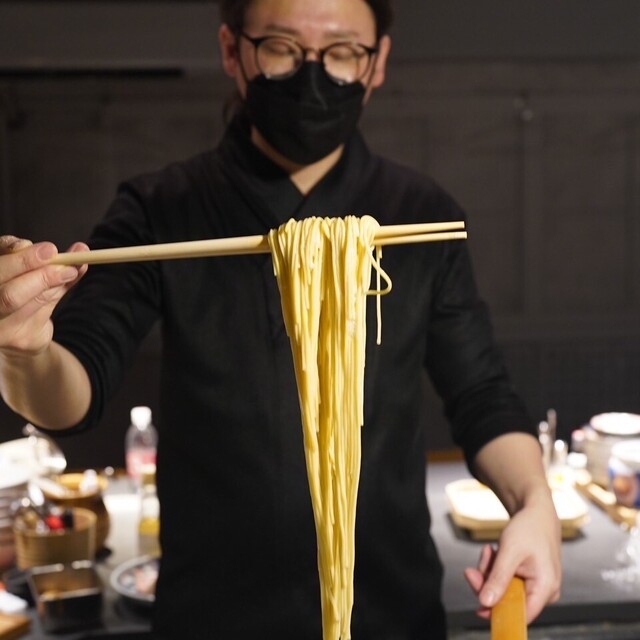
It is a straight type of thin noodle, and as you can see from the visible grains, it contains whole grain flour.
You can feel the chewy texture and firmness, and the aroma and taste of wheat.
The konbu water has the flavor and aroma of kelp, and the lime is added, so you can also feel the scent of lime.
It seems like the noodles are finished with cold water rather than ice water, and I personally would have preferred the noodles to be more seasoned.
When ordering Nihonshu (Sake), you can choose a small plate for a small amount of noodles, similar to how you can choose a choco when ordering Nihonshu (Sake).
As you may have noticed, the tableware is luxurious.
salt

We will sprinkle some salt on the table.
I got the impression that the salt was coming through directly, and I didn't really get the impression that the wheat or kelp stood out.
dipping sauce


The dipping sauce is based on soy sauce and chicken, and you can really feel the aroma and flavor of chicken.
When you eat it with dipping sauce, you can feel the aroma of soy sauce, chicken, and wheat, and it's delicious.
chicken char siu

Chicken chashu is breast meat that is cooked at a low temperature.
It feels moist and flavorful.
It's a taste that you can barely reproduce at home with a low-temperature cooker, but it's delicious because you can rarely get this taste.
fillet chashu

Char siu made with rare fillet meat
It's moist and meaty, and it's also delicious.
roast pork

The pork loin is a rare type.
It's moist, juicy, and has a firm texture.
It's nice to have two pieces of this because it's filling and satisfying.
shrimp wonton

You can enjoy the crisp texture of the shrimp and the soft texture of the dough.
Since it is soaked in dipping sauce, the flavor soaks in and is delicious.
Flavored egg

Ajitama (Seasoned Egg) is half-boiled, but I think the yolk is firmer among the half-boiled varieties.
This tasted pretty normal.
table seasonings

There are plenty of tabletop seasonings.
Place the noodles on a small plate, sprinkle with table seasonings, and enjoy.
Plum soup

It had a plum flavor, but I didn't really feel the soup stock.
Citrus soup

It has a strong citrus and dashi flavor and is delicious.
It's at the level where you want to keep it as is or dilute it with a small amount of hot water and put it in your water bottle.
Aedama (Seasoned Extra Noodles)

When you finish eating Tsukemen (Dipping Noodles) noodles, ask for Aedama (Seasoned Extra Noodles).
Hokkaido Cherry Valley duck Aedama (Seasoned Extra Noodles).

The noodles are different from Tsukemen (Dipping Noodles), they are thin noodles with a stronger wheat flavor.
It is boiled quite hard and has a crunchy texture.
You have to mix it thoroughly before you eat it, and the noodles are coated with duck fat, giving you a strong duck aroma.
Soy sauce is used as the base of taste.

If you dip it in Tsukemen (Dipping Noodles)'s dipping sauce, it will become even more salty.
It's not umami but salty, so it's quite salty.
It's better to eat this normally. .
Aedama (Seasoned Extra Noodles) was good with or without it.
Impressions and Rating
Dashi no TorikoIt was delicious.
Google Maps reviews say that it is for inbound tourists, but I personally think that the Tsukemen (Dipping Noodles) I received this time is worth the price, or rather cheap, and is not for inbound tourists.
The reservation-only menu includes dishes such as wagyu beef and spiny lobster, so I think these are definitely aimed at inbound tourists. .
There are many ways to eat the noodles, including table seasonings, but personally, I like them with dipping sauce, as is, with citrus soup, salt, and plum in that order.
In the case of Kombusui Tsukemen (Kelp-Water Dipping Noodles), the best way to eat the noodles is to eat them as is or with salted seaweed, and the dipping sauce was often used as a soup, but at this restaurant, it was best to dip them in the dipping sauce.
In that sense, I think it was a store that slightly disrupted the concept.
Although reservations are required, it was relatively easy to get a reservation when I visited, so I would like to visit again when I have something to do nearby.
That's what I thought, but at the time of writing this blog, it was becoming difficult to make reservations. .
Taste: ★★★★★★★☆☆☆ (7)
Cost performance: ★★★★★★☆☆☆☆ (6)
Revisit: ★★★★★★★☆☆☆ (7)
Summary
- Reservation required/address not disclosed
- Tsukemen (Dipping Noodles) store where members-only Japanese cuisine SHIKIBU is served
- High quality chashu
- Plenty of table seasonings
- The most delicious way to eat noodles is to dip them in dipping sauce.